





As part of the environmental management of a VEOLIA site classified as an ICPE in the Finistère region of France, a noise problem linked to two atmospheric emission stacks required the installation of a high-performance acoustic system. Here’s a look back at a successful intervention, in line with regulatory requirements and industry best practice.
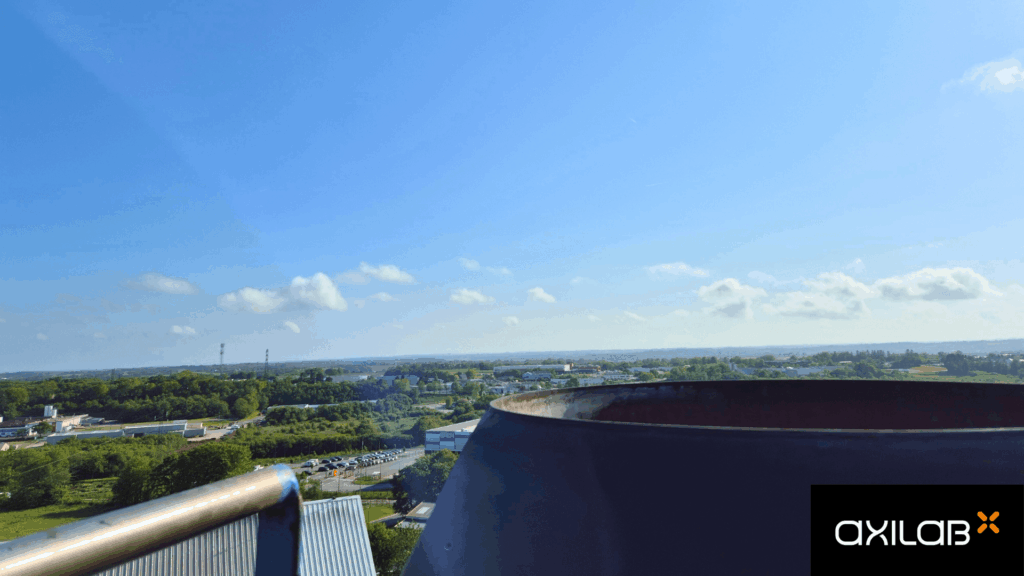
Regulatory context and site issues
VEOLIA’s industrial site is classified as an Installation Classée pour la Protection de l’Environnement (ICPE). As such, it is subject to strict regulations concerning noise pollution, particularly in the Zones à Émergence Réglementée (ZER) located close to residential areas.
An acoustic measurement campaign revealed that noise emissions from the two atmospheric discharge stacks were the main sources of noise perceived by local residents, particularly at night.
The levels measured exceeded the regulatory thresholds defined by thedecree of January 23, 1997. Corrective action was therefore essential to comply with legal requirements and limit the impact on the neighborhood.
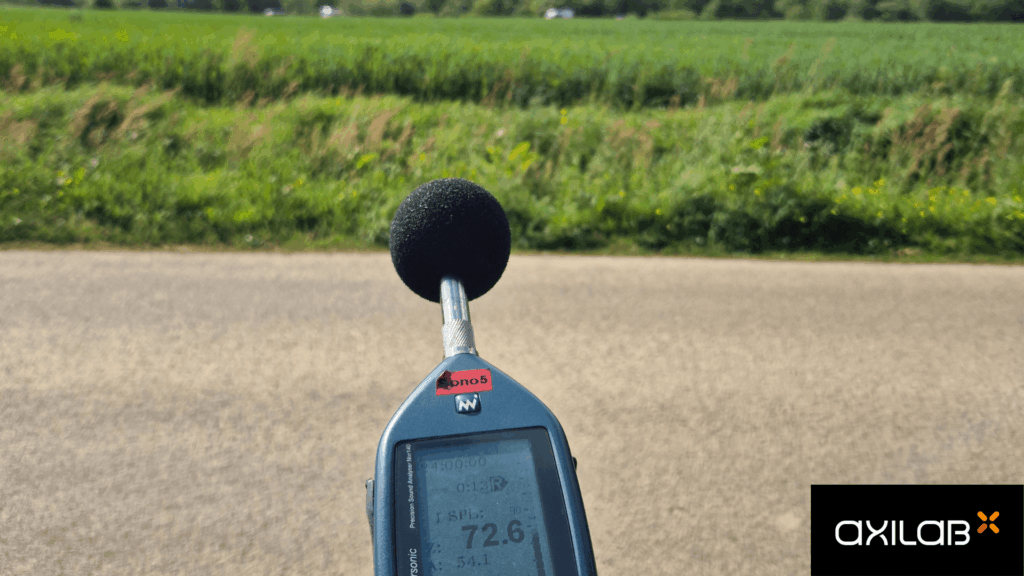
Customized diagnostics and technical approach
Identification of emission spectra
A new campaign of in situ acoustic measurements enabled us to characterize the emission spectra specific to each stack. This step enabled us to target the frequency bands that contribute most to ambient noise, and served as the basis for sizing acoustic silencers.
Sizing insertion silencers
Based on these results, AXILAB designed insertion silencers to meet the technical constraints of the site: high effluent temperature, permissible pressure drop and mechanical integration into the industrial environment.
The main objective was to achieve targeted spectral attenuation, while guaranteeing the durability of the equipment and the absence of impact on the industrial process.
AXILAB was able to count on the CL2R teams to carry out all the integration work on the incinerator exhaust lines:
- Opening the front of the building to create a hoistway
- Removal of thermal insulation from existing ducts
- Securing and recharging existing ducts
- Cutting and removing duct sections
- Installation and welding of counter-flanges
- Lifting and installing silencers
- Reassembling the building’s façade
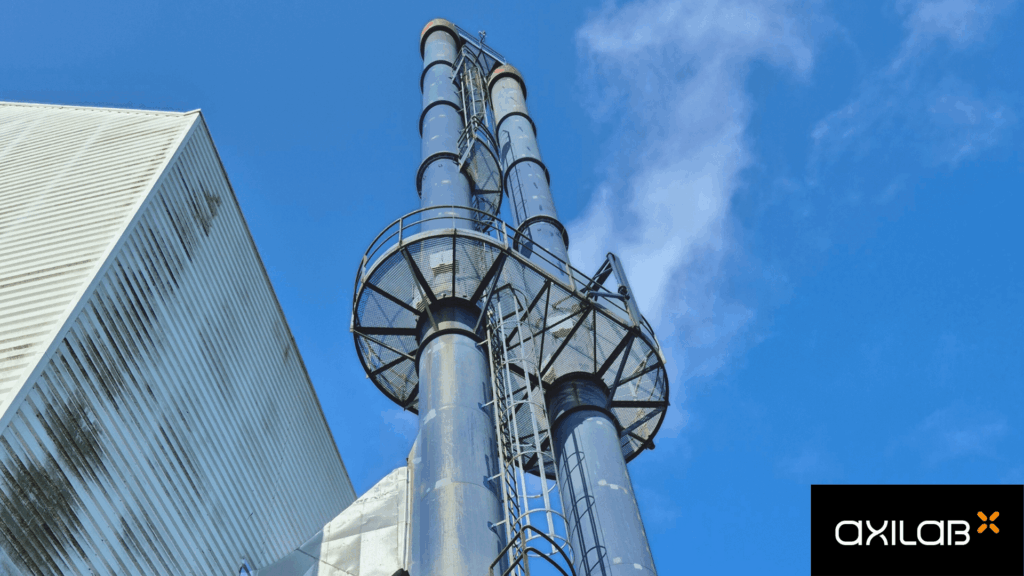
Results: targeted and effective mitigation thanks to joint expertise
The silencers installed are of the reactive dissipative type, offering precise spectral attenuation in the frequency bands that contribute most to ambient noise. They provide an acoustic gain of :
- Line 1 – North: acoustic gain of 7 dB(A)
- Line 2 – South: noise reduction of 15 dB(A)
After installation by CL2R, an acoustic acceptance measurement campaign was carried out in accordance with the reference standards NF S 31-010 and ISO 1996-2. It confirmed that noise levels complied with regulatory objectives.
An approach in line with Directive 2002/49/EC

This intervention is fully in line with the requirements of the directive 2002/49/EC relating to the assessment and management of environmental noise. It reflects VEOLIA’s (find out more about VEOLIA) and AXILAB’s commitment to the sustainable reduction of the noise footprint of industrial facilities vis-à-vis their neighbors, while strengthening the company’s environmental performance.
Conclusion
Thanks to a rigorous acoustic assessment and an adapted technical approach, AXILAB enabled the VEOLIA site to regain regulatory compliance while improving the acoustic comfort of the neighborhood. This case study provides a concrete illustration of AXILAB’s expertise in acoustic diagnostics, the dimensioning of sound treatment solutions andpost-intervention assessment.
Lexicon
- Spectral attenuation: Targeted reduction of noise levels in specific frequency bands, to deal effectively with the most annoying nuisances.
- Frequency bands: ranges of sound frequencies analyzed separately to identify noise sources and target acoustic treatments.
- Installation Classée ICPE: Industrial site subject to specific regulations due to its potential impact on the environment (risks to health, safety and the environment).
- Permissible pressure drop: Maximum pressure drop that a fluid can undergo as it passes through a piece of equipment without affecting the smooth operation of the industrial process.
- Insertion silencer: Acoustic device inserted in a pipe or chimney to attenuate the noise generated by gas flows.
- ZER (Zone à Émergence Réglementée): Sensitive area (homes, schools, etc.) around an industrial facility where noise levels must remain below regulatory thresholds to protect the neighborhood.


